


The Difference at a Glance
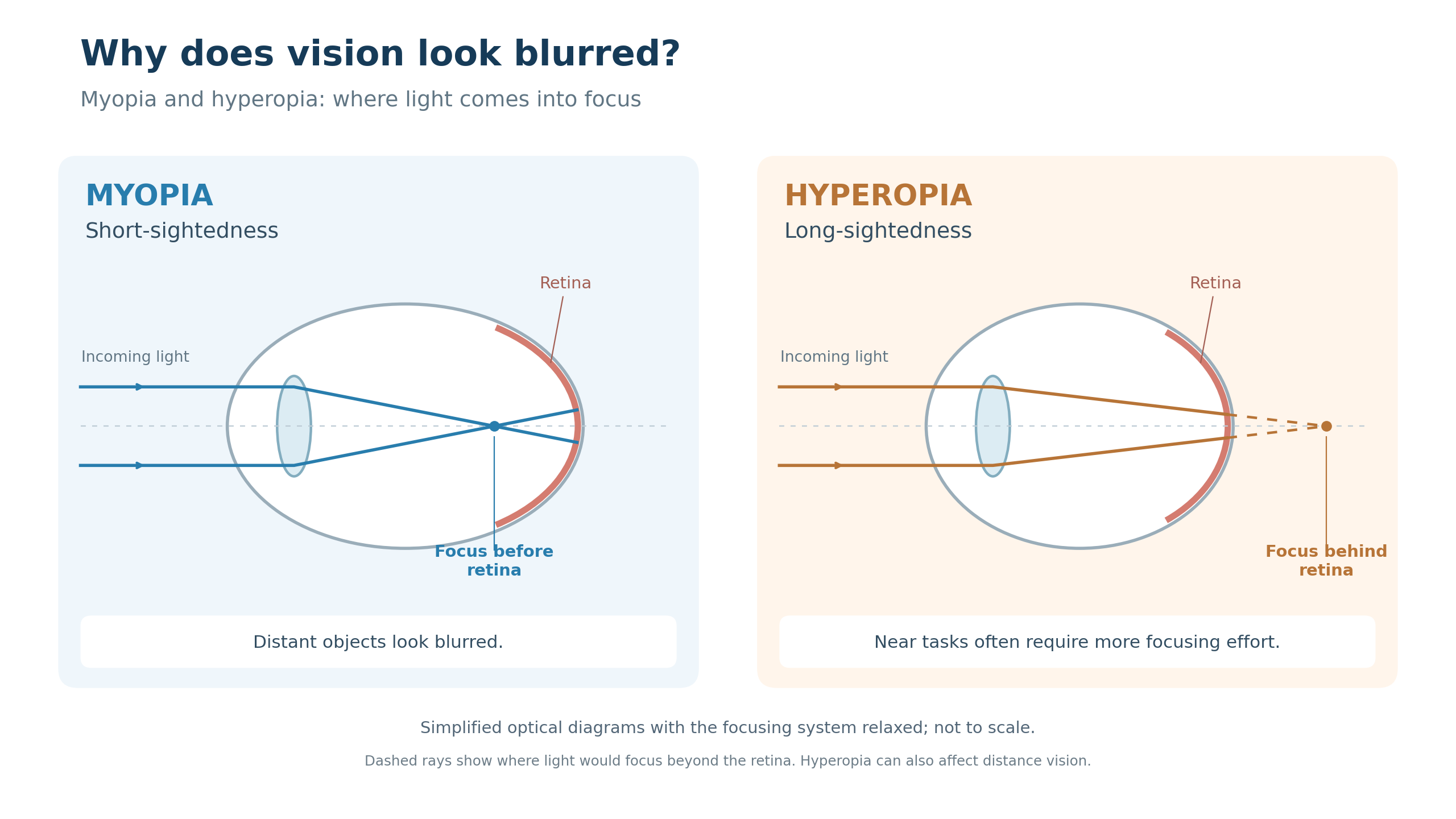
Myopia is short-sightedness: distant objects look blurred because light focuses in front of the retina. Hyperopia is long-sightedness: nearby objects often require more focusing effort because, when the eye is relaxed, light would focus behind the retina. Both involve a mismatch between the eye’s length and its focusing power.
The names describe which viewing distance is usually easier. They do not mean that everyone with myopia has perfect near vision or that everyone with hyperopia sees clearly in the distance.
MYOPIA
Closer Is Usually Clearer
You can read your phone, but the road sign or television across the room looks blurred.
HYPEROPIA
Close Work Can Be Harder
Reading or using a screen may feel tiring. Distance may be clearer, but can also be affected.
How Does the Eye Focus Light?
Think of your eye as a camera. To produce a clear image, it needs to bring incoming light into focus precisely on the retina, the light-sensitive tissue at the back.
The Cornea
The clear front surface bends light as it enters your eye.
The Natural Lens
The lens inside helps adjust focus between different distances.
The Retina
This receives the image, rather like the sensor inside a camera.
If the eye’s length and focusing power do not match, light does not focus in the right place. This is called a refractive error.
Myopia: Why Does Distance Look Blurry?
In a short-sighted eye, the eyeball is often too long relative to its focusing power. Sometimes the cornea or lens bends light too strongly. Either way, light from distant objects comes into focus before reaching the retina.
By the time it reaches the retina, the light has started to spread out again, producing a blurred image.
Why Is Nearby Vision Often Better?
Light from a nearby object enters the eye differently from light arriving from far away. Moving an object closer can bring its focus towards the retina in a myopic eye.
The clearest distance depends on your prescription. Someone with stronger myopia may need to hold a book much closer than someone with mild myopia.
Everyday Clues
- Road signs become readable only as you get closer.
- Faces across a room look less distinct.
- Television subtitles or classroom boards appear blurred.
- You squint to make distant details clearer.
Hyperopia: Why Is Close Work More Demanding?
In a long-sighted eye, the eyeball is often too short relative to its focusing power, or its optical surfaces do not bend light strongly enough.
With the focusing system relaxed, light would meet behind the retina. Reading something close requires additional focusing power, making near tasks particularly demanding.
Why Do Some Long-Sighted People See Clearly Without Glasses?
The natural lens can change shape to increase its focusing power. This adjustment is called accommodation.
Younger people may compensate for some hyperopia this way, sometimes seeing clearly at both near and distance. However, that extra effort can cause tired eyes or headaches during prolonged close work.
As the lens becomes less flexible with age, previously manageable hyperopia can become more noticeable.
Long-Sighted Does Not Mean Perfect Distance Vision
Higher hyperopia, or a reduced ability to compensate, can blur distant objects too. The name describes a common pattern rather than a rule that applies to everyone.
Myopia and Hyperopia Compared
These are typical differences before glasses, contact lenses or surgery.
| Feature | Myopia | Hyperopia |
|---|---|---|
| Common name | Short-sightedness | Long-sightedness |
| Main difficulty | Seeing distant objects clearly | Close work; distance may also be affected |
| Focus when the eye is relaxed | In front of the retina | Would fall behind the retina |
| Typical eye length | Too long for its focusing power | Too short for its focusing power |
| Distance prescription: SPH | Minus: for example, −2.00 | Plus: for example, +2.00 |
| Correction options | Glasses, contacts and suitable laser or lens procedures | Glasses, contacts and suitable laser or lens procedures |
A COMMON MIX-UP
Is Hyperopia the Same as Needing Reading Glasses After 40?
No. Hyperopia and presbyopia are different conditions, although both can make close work difficult.
Hyperopia
The eye’s length and focusing power do not match.
Presbyopia
The natural lens becomes less flexible with age, reducing close focusing ability.
You can develop presbyopia whether you are short-sighted, long-sighted or have never previously needed glasses.
Why Do Short-Sighted People Take Their Glasses Off to Read?
Distance glasses correct myopia so faraway objects become clear. Once presbyopia develops, reading through that distance correction may become difficult.
Removing the glasses can let a short-sighted person use their naturally closer focusing range. It does not mean their myopia has disappeared or that their eyes have avoided ageing.
How Do You Know Which Condition You Have?
An eye examination measures your prescription and checks eye health. Looking through different lenses helps establish which correction gives you clearer vision.
Where appropriate, drops can temporarily relax the focusing system to reveal long-sightedness that the eye has been compensating for.
Blurred vision is a symptom, not a diagnosis. Astigmatism, presbyopia and other eye conditions can also affect clarity, sometimes alongside myopia or hyperopia.
How Can Myopia and Hyperopia Be Corrected?
The aim is to bring light into focus on the retina. Your prescription, age, eye health and everyday visual needs help determine the options.
01 · GLASSES AND CONTACT LENSES
Adjusting Light Before It Enters Your Eye
Minus lenses used for myopia spread incoming light slightly. Plus lenses used for hyperopia bring it together.
Both conditions can usually be corrected without surgery. If presbyopia is also present, your prescription may need extra support for reading and intermediate tasks.
02 · LASER EYE SURGERY
Changing the Cornea’s Focusing Power
For myopia, laser treatment generally flattens the central cornea. For hyperopia, it changes the surrounding curvature to make the central cornea relatively steeper.
LASIK or surface laser procedures may be considered for suitable prescriptions. The technique offered depends on your assessment and the available treatment platform.
Checks include prescription stability, corneal shape and thickness, the tear film and wider eye health.
03 · IMPLANTABLE CONTACT LENSES
Adding a Lens Inside the Eye
An implantable contact lens adjusts focusing power while leaving your natural lens in place. It does not remove corneal tissue in the way laser correction does.
It may be considered for suitable patients with higher prescriptions or when corneal laser treatment is unsuitable.
Lens options depend on your prescription and the space and anatomy inside the eye. Availability differs for myopia and hyperopia.
04 · LENS REPLACEMENT
Replacing the Natural Lens
An artificial intraocular lens replaces the natural lens, with its power calculated to help correct the eye’s focusing error.
This may be considered when age-related lens changes or cataracts are relevant. Removing a cloudy lens is cataract surgery; surgery primarily to reduce dependence on glasses is commonly called refractive lens exchange.
Implant choice involves balancing visual priorities, the likely need for glasses and possible effects such as glare or halos.
Your Prescription Is Only Part of the Decision
Two people with the same prescription may need different advice. Corneal health, the condition of the natural lens and other eye findings can all change the recommendation.
Surgery can reduce dependence on glasses, but it does not guarantee lifelong freedom from them. It also carries risks, which should be discussed alongside the benefits and alternatives.
A detailed assessment answers three important questions: What is causing the blur? What can realistically be improved? How might your vision change over time?