


Implantable Lenses or Laser Surgery For Your Eye Perscription
Most patients don’t arrive asking for a specific procedure.
They come in with a question that sounds much simpler.
“Can this be fixed… and what’s the best way to do it?”
The answer depends on a few things, but prescription range is one of the clearest starting points. It tells us how your eye focuses light, how much correction is needed, and whether reshaping the cornea or working inside the eye will give the best result.
From there, we look at age, corneal thickness, and how you actually use your vision day to day.
Understanding Prescription Range in Real Terms
A prescription is usually measured in dioptres, shown as plus or minus numbers.
Lower prescriptions tend to be easier to correct with laser. As the numbers increase, the amount of tissue that would need to be removed becomes more significant, and that’s where other options begin to make more sense.
But prescription alone is never the full story. Two people with the same number can still be better suited to different treatments.
That’s where clinical judgement comes in.
A Clinical Guide to Treatment by Prescription Range
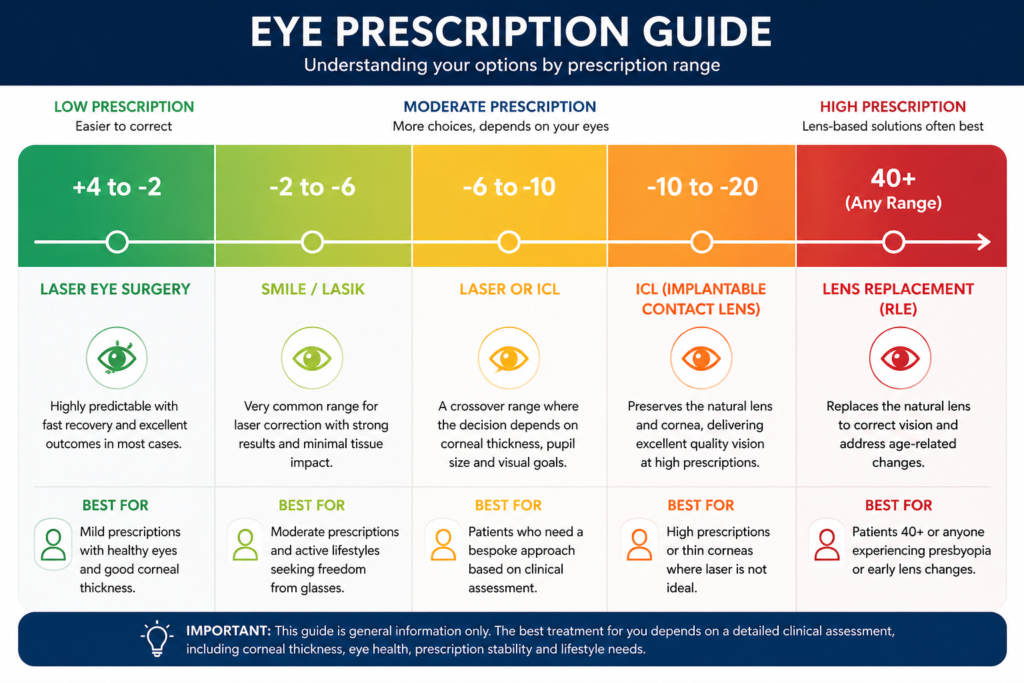
| Prescription | Most Suitable Treatment | Clinical Perspective |
|---|---|---|
| +4 to -2 | Laser Eye Surgery | Highly predictable, minimal correction needed, fast recovery and excellent outcomes in most cases. |
| -2 to -6 | SMILE or LASIK | A very common range for laser, where modern techniques preserve corneal strength while delivering high-quality vision. |
| -6 to -10 | Laser or ICL | This is a crossover zone. Decision depends on corneal thickness, pupil size, and long-term visual expectations. |
| -10 to -20 | ICL (Implantable Lens) | Often preferred at higher prescriptions, preserving the cornea and providing better optical quality. |
| 40+ (any range) | Lens Replacement (RLE) | Addresses presbyopia and ageing lens changes, often reducing dependence on reading glasses completely. |
When Laser Eye Surgery Makes the Most Sense
Laser works by reshaping the cornea. That makes it incredibly effective, but only within certain limits.
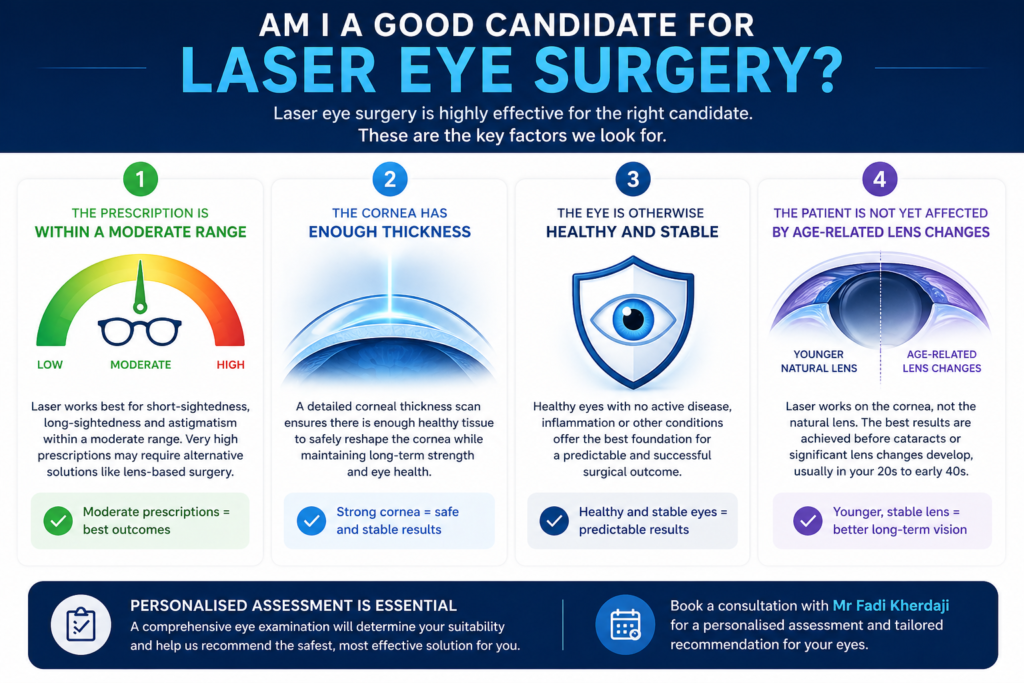
In general, laser is the right choice when:
- The prescription is within a moderate range
- The cornea has enough thickness
- The eye is otherwise healthy and stable
- The patient is not yet affected by age-related lens changes
When those conditions are met, the results are often excellent. Recovery is quick, and the procedure has been refined over decades.
But laser is not designed to solve every type of vision problem.
When Lens-Based Surgery Becomes the Better Option
As prescriptions increase, or as the natural lens begins to change with age, the limitations of laser become clearer.
This is where lens-based solutions come in.
Implantable contact lenses (ICL) work by placing a lens inside the eye without removing any tissue. This allows for precise correction even in higher prescriptions.
Lens replacement goes one step further. It replaces the natural lens entirely, which means it can address not just distance vision, but also intermediate and near vision, particularly important for patients over 40.
In many ways, this is less about “fixing vision” and more about redesigning how the eye focuses altogether.
Why It’s Never Just About the Numbers
It’s easy to focus on prescription ranges as fixed rules.
In reality, they are just a starting point.
Two patients with the same prescription can have completely different outcomes depending on:
- corneal thickness
- eye shape
- pupil behaviour in low light
- lifestyle and visual demands
That’s why no responsible clinic will recommend a treatment based on numbers alone.
A Final Thought From Fadi
The question isn’t really:
“Which treatment is best?”
It’s:
“Which treatment is best for the way you want to see the world over the next 10 or 20 years?”
For some patients, laser is the perfect solution. Simple, effective, and transformative.
For others, particularly those with higher prescriptions or changing vision with age, lens-based treatments offer something different, stability, flexibility, and long-term clarity.
The important thing is understanding where you are now, and choosing a solution that fits not just your eyes, but your future.