


Why Vision Correction Demand Is Quietly Rising Faster Than Ever
There isn’t a single moment when people realise their vision is changing. It happens gradually:
A menu becomes harder to read in low light.
A phone is held slightly further away than before.
Driving at night feels a little more uncomfortable, not because the road has changed, but because the way light is being processed has.
For many, it’s easy to dismiss. A natural part of getting older. Something to work around rather than question. But across the UK, something much bigger is happening beneath those small, everyday adjustments.
A Shift You Don’t See, But You Feel
The UK population is aging. That part isn’t new.
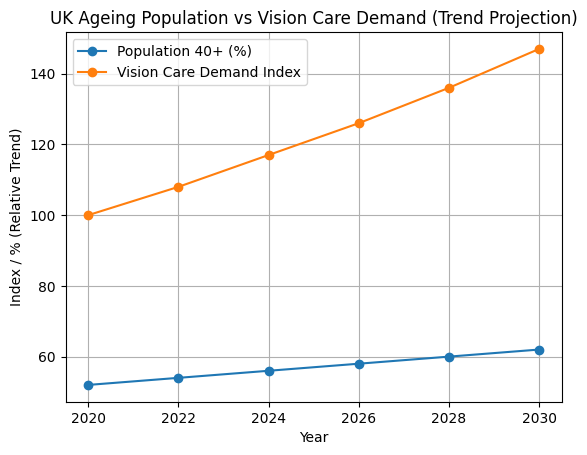
What is new, however, is how this is beginning to affect vision care demand at scale. More people are entering the stage of life where the eye itself begins to change, not just in clarity, but in how it functions.
Conditions such as cataracts, presbyopia, and other age-related changes are becoming more common, not because something has gone wrong, but because people are living longer, working longer, and relying on their vision in more demanding ways than ever before.
Screens, artificial lighting, and modern working environments have amplified this further. What may have once been a mild inconvenience is now something that affects daily performance, comfort, and quality of life.
From “Managing Vision” to “Fixing It”
For years, the default response has been simple.
Reading glasses. Stronger prescriptions. Adjustments.
But there is a noticeable shift happening in how people respond to these changes.
More patients are now asking different questions.
Not:
“Do I need stronger glasses?”
But:
“Is there a way to fix this properly?”
This is where modern vision correction has started to move into focus.

The Rise of PRESBYOND® and Lens-Based Solutions
For patients over 40, traditional laser eye surgery is not always the starting point.
At this stage, the issue is often not just how light enters the eye, but how the eye focuses at different distances. The natural lens begins to lose flexibility, making near vision more difficult while distance vision may still feel relatively stable.
Treatments such as PRESBYOND® have been developed specifically for this transition. Rather than correcting a single focal point, they create a balanced visual system, allowing patients to move more naturally between near and distance vision without relying heavily on reading glasses.
For others, particularly those beginning to experience early cataract changes, lens-based procedures offer a more complete solution. By replacing the natural lens with an advanced artificial lens, clarity can be restored while also reducing long-term dependence on glasses.
These are not niche treatments anymore.
They are becoming part of a broader shift in how aging vision is approached.
Why Demand Is Increasing Now
This rise in demand isn’t happening by accident.
People are staying active for longer.
They are working later into life.
They are using screens more intensively.
And importantly, they are more aware of what is possible.
Vision is no longer seen as something to tolerate.
It is something to optimise.
The idea of “just putting up with it” is slowly being replaced with a more proactive mindset. Patients want clarity, but they also want comfort, flexibility, and independence in how they use their eyes every day.
| Vision Stage / Trend | What Patients Commonly Notice | Modern Treatment Direction | Why It Matters Now |
|---|---|---|---|
| Younger adults with myopia or astigmatism | Blurred distance vision, reliance on glasses or contact lenses, screen fatigue | SMILE Pro, LASIK, PRK or LASEK depending on corneal shape and lifestyle | More patients are seeking long-term freedom from lenses in an increasingly screen-driven world |
| Patients over 40 with early reading vision changes | Difficulty focusing up close, holding phones further away, frustration with reading glasses | PRESBYOND® blended vision laser treatment | Demand is increasing as active adults look for solutions that match modern work and lifestyle needs |
| Patients with early lens changes or cataract-related symptoms | Glare, halos, reduced night vision, fading contrast, growing dependence on glasses | Lens replacement, cataract surgery with trifocal, toric or EDOF lenses | As the UK ages, lens-based solutions are becoming central to the future of vision correction |
| Patients seeking better quality of vision, not just clearer vision | Night driving discomfort, light sensitivity, digital strain, visual fatigue | Advanced diagnostics to guide laser or lens-based treatment selection | The trend is moving beyond basic correction towards personalised, lifestyle-led visual outcomes |
The Overlooked Reality
What makes this trend particularly interesting is how quiet it is.
There’s no sudden surge. No single headline moment.
Instead, it’s happening gradually, across thousands of small decisions being made every day. People choosing to explore options earlier, to understand their eyes better, and to invest in long-term solutions rather than short-term fixes.
Looking Ahead
Over the next decade, this shift will only become more pronounced.
As the UK population continues to age, and as awareness of advanced vision correction grows, demand will naturally follow. Not just for treatments, but for understanding.
For patients, the journey is becoming clearer.
Not defined by age alone, but by how they want to experience their vision moving forward.
Final Thought
Aging vision isn’t a problem to solve. It’s a transition to understand. And for more people across the UK, it’s becoming the point where they stop managing their sight, and start taking control of it.