


2026 Guide
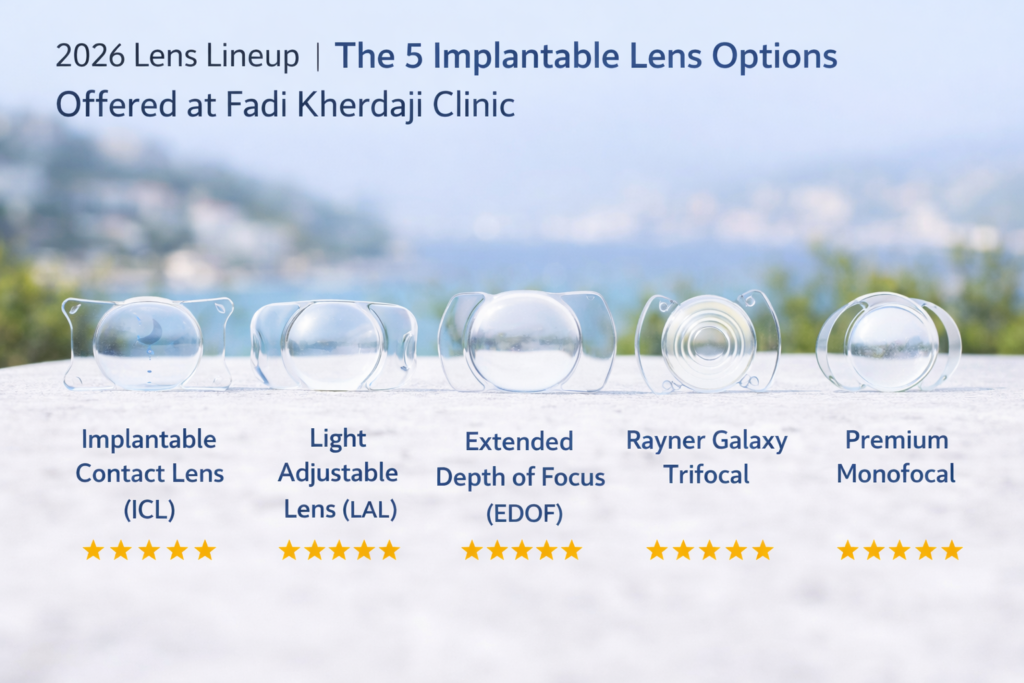
When it comes to advanced vision correction, implantable lenses are no longer one-size-fits-all. In 2026, a range of highly specialised lens technologies are available for different visual needs, lifestyles, and eye conditions.
At Fadi Kherdaji’s clinic in Cheltenham and South Wales, patients can access five main types of implantable lenses, each with distinct goals and benefits. Understanding the differences helps you choose the right path for clearer vision without glasses or daily contact lenses.
Implantable Lens Comparison – 2026 Overview
A simplified comparison of the implantable lens options available. Ratings reflect typical performance characteristics, not an individual medical recommendation. Final suitability depends on detailed eye measurements and consultation.
| Lens Type | Best For | Distance Vision | Intermediate Vision | Near Vision | Night Vision Quality | Reversible | Overall Rating |
|---|---|---|---|---|---|---|---|
| Implantable Contact Lens (ICL) | High prescriptions, thin corneas, younger patients | ★★★★★ | ★★★★☆ | ★★★★☆ | ★★★★★ | ★★★★★ | ★★★★★ |
| Light Adjustable Lens (LAL) | Patients wanting post-surgery customisation | ★★★★★ | ★★★★★ | ★★★★☆ | ★★★★☆ | ✩ (Lens exchange procedure) | ★★★★★ |
| Extended Depth of Focus (EDOF) | Smooth range of vision with minimal halos | ★★★★★ | ★★★★★ | ★★★★☆ | ★★★★☆ | ✩ | ★★★★☆ |
| Rayner Galaxy (Trifocal) | Full range near, intermediate, and distance | ★★★★★ | ★★★★★ | ★★★★★ | ★★★★☆ | ✩ | ★★★★★ |
| Premium Monofocal | Patients prioritising crisp distance vision | ★★★★★ | ★★★☆☆ | ★★☆☆☆ | ★★★★★ | ✩ | ★★★★☆ |
Note: Star ratings reflect typical visual performance characteristics for each category. Individual results vary based on anatomy, prescription, and lifestyle goals.
Here are the five most important implantable lens options available in 2026, ranked in order of clinical advancement and real-world performance.
1. Implantable Contact Lenses (ICL); A Reversible High-Definition Solution
Best for: Younger adults with moderate to high prescriptions or thin corneas.
Implantable Contact Lenses (ICLs) sit behind the iris and in front of your natural lens, acting like a permanent internal contact lens. They are an excellent alternative for patients who may not be suitable for laser eye surgery due to thin corneas, dry eyes, or very high prescriptions. Unlike corneal laser procedures, they preserve the natural shape of the cornea.
ICLs deliver sharp, natural vision and are fully reversible, meaning they can be removed or replaced if needed. This makes them particularly appealing for active lifestyles, sports, travel, and everyday activities where you want consistent, glasses-free sight without altering corneal structure.
2. Light Adjustable Lenses; Personalised Vision You Fine-Tune After Surgery
Best for: Patients who want tailored vision outcomes after cataract or lens replacement surgery.
Light Adjustable Lenses (LAL) are one of the most innovative implantable lens technologies available. Unlike fixed lenses, they can be customised after surgery using controlled UV light treatments. Once your eye heals, your surgeon can fine-tune the lens power based on how you see in your daily life.
This “test-drive vision” approach is revolutionary because it allows adjustments once the eye has settled, rather than relying on predicted outcomes from pre-operative measurements alone. The result is exceptionally personalised visual clarity, reducing dependence on glasses for daily life.
3. Extended Depth of Focus (EDOF) Lenses; Smooth Vision Across Distances
Best for: Adults who want a broader range of vision without the common side effects of multifocal lenses. Extended Depth of Focus lenses bridge the gap between simple monofocal implants and more complex multifocal/trifocal designs. EDOF technology delivers continuous focus from near to intermediate to distance, without the harsh visual artifacts (like halos or glare) sometimes associated with older multifocal lenses.
For people who work on screens, drive frequently, or want reliable everyday vision without switching glasses, EDOF lenses provide a smooth visual experience with strong distance clarity and a comfortable transition between focal points.
4. Rayner Galaxy Lenses; Next-Generation Trifocal Optics
Best for: Patients who want glasses-free vision at every distance.
Rayner Galaxy lenses are advanced trifocal intraocular lenses designed to replace the natural lens during cataract or refractive lens exchange surgery. Unlike traditional multifocal optics that split light into separate focal zones, Galaxy lenses use a spiral, non-diffractive design that gently extends focus. This provides smoother, more natural vision across near, intermediate, and distance ranges.
These lenses are particularly popular with active adults who want consistent clarity for reading, driving, screen work, and everyday life without the need for external eyewear.
5. Premium Monofocal Lenses; Crystal-Clear Distance Vision
Best for: Adults seeking sharp, high-definition vision at a single focal distance.
Premium monofocal lenses are a trusted choice for patients who prioritise exceptional distance vision, often during cataract surgery or refractive lens exchange. These lenses focus light at one specific distance, typically for clear distance vision and they deliver excellent optical quality with minimal visual disturbances like halo or glare.
While patients may still need glasses for near tasks such as reading, the clarity and contrast achieved with premium monofocal lenses make them ideal for driving, outdoor activities, and hobbies that demand crisp long-range sight.
So, What’s the Difference Across These Lens Types?
Rather than thinking in terms of “best overall,” it’s more useful to think in terms of what problem you’re solving and what lifestyle you want to support:
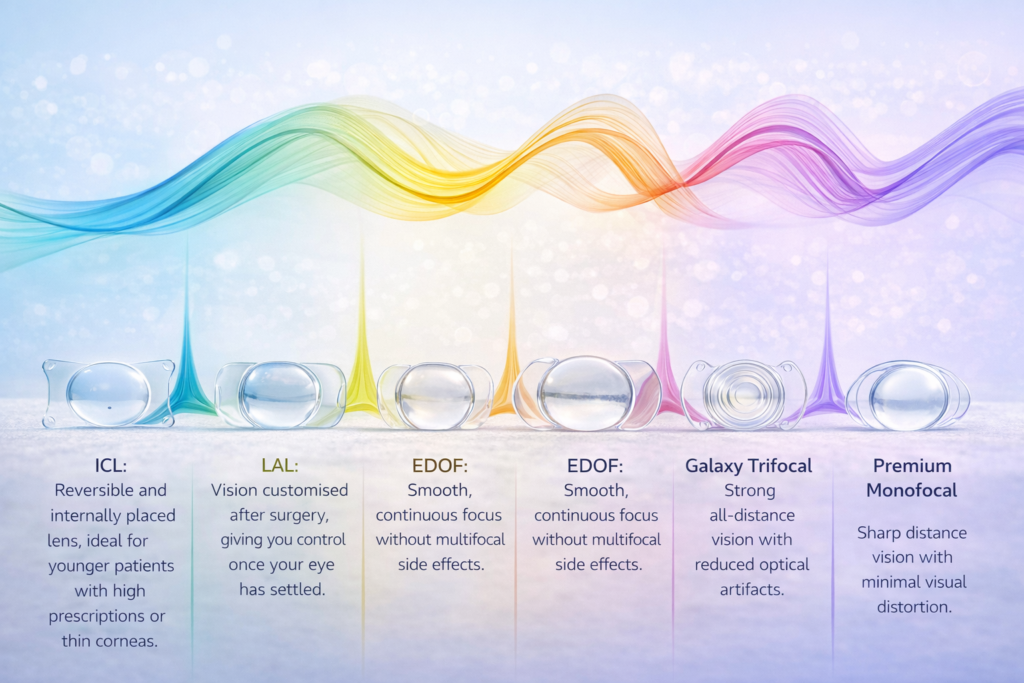
- ICL: Reversible and internally placed lens, ideal for younger patients with high prescriptions or thin corneas.
- LAL: Vision customised after surgery, giving you control once your eye has settled.
- EDOF: Smooth, continuous focus without multifocal side effects.
- Galaxy Trifocal: Strong all-distance vision with reduced optical artifacts.
- Premium Monofocal: Sharp distance vision with minimal visual distortion.
Why Having Options Matters
Everyone’s eyes are different.
Not all lenses are suitable for every eye, and what works best depends on:
- Your prescription and eye anatomy
- Your visual priorities (distance, reading, screens, night driving)
- Your age and general eye health
- Whether you’re having cataract surgery or refractive lens exchange (RLE)
A personalised consultation with a specialist like Dr. Fadi Kherdaji helps match the right lens to your vision goals and lifestyle.
Who Is Choosing ICL in 2026?
Across the UK, the strongest uptake remains among:
High myopes in their twenties and thirties.
Athletes wanting stable, non-drying correction.
Professionals who work long hours on screens.
Patients with thin corneas unsuitable for laser.
Individuals who value reversibility.
The demographic is broadening, but suitability remains anatomical rather than trend-driven.
So What Is the Best Implantable Contact Lens in 2026?
For many suitable patients, modern implantable lens technology offers exceptional clarity and long-term stability. However, choosing the right lens is not about selecting the newest model. It is about precision, safety, and suitability. The most effective lens is the one that aligns with your eye anatomy, prescription strength, lifestyle demands, and long-term vision goals.
Technology matters. But correct selection matters more.